Atlantis—just the name conjures up a world beneath the waves. The story comes to us through Plato’s dialogues, and a real Atlantis has not been established by physical evidence. Let’s separate what the ancient account says from later speculation.
Where Did the Legend of Atlantis Begin?
The story of Atlantis comes from the ancient Greek philosopher Plato, who wrote about it in two of his dialogues, Timaeus and Critias, around 360 BCE.
What Plato Said:
- Atlantis was a powerful and advanced civilization located beyond the “Pillars of Hercules” (modern-day Strait of Gibraltar).
- It was larger than Libya and Asia combined, incredibly wealthy, and technologically advanced.
- In the story, Atlantis attacked other peoples and Athens resisted. Plato describes earthquakes and floods that swallowed the island in a day and night; the surviving Critias ends before completing the narrative.
Plato presented Atlantis as a cautionary tale—a warning against hubris and greed. But was it purely fictional, or based on a real place?
Popular Theories About Atlantis
The search for Atlantis has led to countless theories. Here are some of the most intriguing:
1. Proposed Real Locations
Some have proposed real locations as inspirations or possible sites, but none is established as Plato’s Atlantis:
- Santorini, Greece: The eruption of Santorini and Minoan history have been proposed as possible inspirations; a resemblance does not establish that the island was Atlantis.
- The Azores: Located in the Atlantic Ocean, some theorists point to this archipelago as a possible remnant of Atlantis.
- The Bahamas: The mysterious underwater “Bimini Road” near the Bahamas has sparked speculation about ancient, submerged structures.
2. Atlantis as a Metaphor
Others argue that Atlantis was purely allegorical:
- Plato may have invented it as a fictional example of an ideal society gone wrong.
- The story could symbolize the rise and fall of human civilizations, a theme that resonates across history.
3. Extraterrestrial Origins
And then there’s a more out there idea, without evidence establishing it:
- Some believe Atlantis was a colony of advanced aliens who shared their knowledge with humans. (Cue the History Channel’s “Ancient Aliens” music.)
4. A Different Irish Tradition
The Tuatha Dé Danann belong to Irish mythological traditions, separate from Plato’s account of Atlantis. Similarities between stories do not establish a historical connection.
- Comparing myths can be entertaining, as can reading stories about creatures of the sea like mermaids. Neither comparison provides evidence of an Atlantean exodus.
Key Clues (or Red Herrings?)
- Plato’s Description
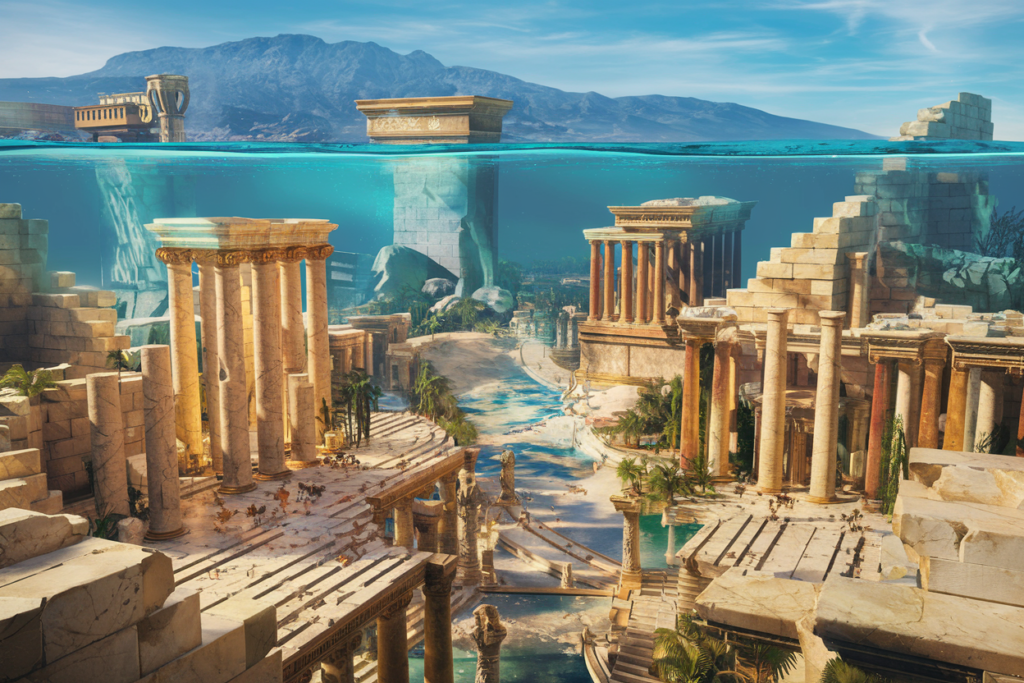
- He described Atlantis in great detail, from its circular canals and temples to its gold-covered walls. Was he being literal or just showing off his storytelling skills?
- The Pillars of Hercules
- Plato placed Atlantis “beyond the Pillars of Hercules,” leading many to focus their searches in the Atlantic Ocean. The reference belongs to Plato’s narrative and does not by itself identify a real site.
- Sudden Destruction
- Atlantis supposedly disappeared in a single day. Could this refer to a real natural disaster, like a tsunami, earthquake, or volcanic eruption?
Why Are We So Obsessed With Atlantis?
Atlantis taps into our collective imagination for several reasons:
- The Idea of a Lost World
- A grand island realm swallowed by the sea is a compelling image, even though Plato’s story also describes its attempted conquest.
- The Allure of the Unknown
- Sunken ruins, mysterious maps, and hidden secrets? Yes, please.
- A Cautionary Tale
- The story warns against arrogance, greed, and the misuse of power—lessons that still resonate today.
Fun Facts About Atlantis
- Island and City
- Plato described an island and its capital city. His account is a literary source, not a map of a confirmed archaeological site. See the translated extracts from the dialogues.
- A Story of Conflict
- In Plato’s account, Atlantis attacks other lands and Athens resists. That conflict is part of the dialogue’s story, not independent evidence of a historical war.
- Pop Culture Loves Atlantis
- From Disney’s Atlantis: The Lost Empire to Aquaman’s underwater kingdom, Atlantis has become a staple of books, movies, and TV shows.
- Many Proposed Locations
- Locations ranging from Antarctica to the Sahara have been proposed, but a proposal is not proof of discovery.
The Modern Search for Atlantis
Advances in technology, like underwater drones and satellite imaging, have made the search for Atlantis more sophisticated. Some recent claims include:
- The Richat Structure (Eye of the Sahara): A circular geological formation in Mauritania sometimes compared with the story’s rings; resemblance alone does not establish a connection.
- Antarctica: Some theorists believe Atlantis lies beneath the ice, hidden for millennia.
None of these proposals establishes Atlantis as a historical place. For one example of a false online discovery claim, NOAA explains that apparent ocean-floor lines in a map result from the way survey data was assembled.
What If Atlantis Were Real?
Let’s play “what if” for a second. If Atlantis were real, it would fundamentally change how we understand ancient civilizations. Any real archaeological discovery would need to be studied on its own evidence before drawing conclusions about what it reveals.
Or… it might just be another ancient city with a good PR team (thanks, Plato).
Final Thoughts
Atlantis endures as a story that invites questions about power, history, and imagination. Its literary legacy is real; claims about an actual lost civilization need independent evidence.
What do you think—real or myth? Let’s hear your theories in the comments, whether you’re team “hidden under the ocean” or team “Plato just made it up.”